

Gueydan residents arrested in “The Peanut Man” sting for selling wild game were taken to a staging area in town where they were loaded onto buses and transported to Lafayette for arraignment.
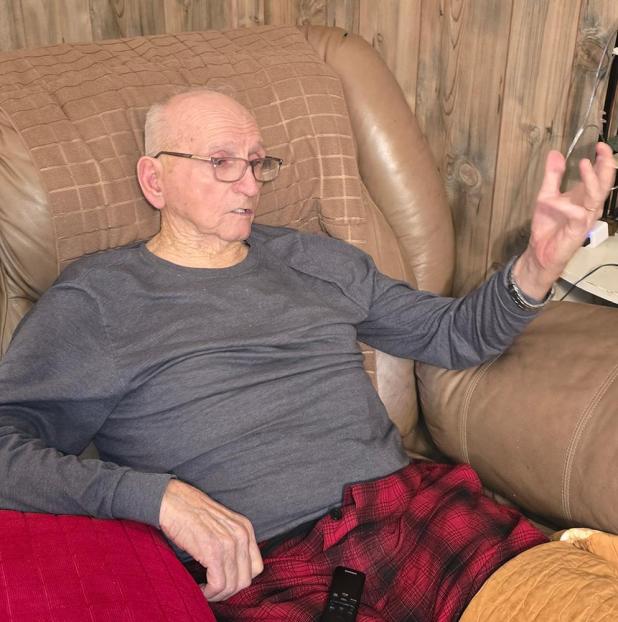
Robert “Bobby” de’Perrodil was just a teenager the morning federal agents descended upon his home to arrest his father in an elaborate sting that ended in the arrest of more than 60 residents from the Gueydan area on charges of selling wild game.

The October 1961 edition of Sports Afield included an article by author Paul Kalman that was teased with a cover headline: “Special Expose: I Hunt the Market Hunter.”
‘The Peanut Man’
GUEYDAN — It’s been 64 1/2 years, but Robert “Bobby” de’Perrodil remembers the events that unfolded here on May 5, 1961, as if it were yesterday — and how the infamous “Legend of The Peanut Man” became local lore.
His memories put a different twist on a tale that garnered national headlines, cast Gueydan in a negative light as a place with little or no regard for conservation or wildlife laws, and was lauded by a media that portrayed an ambitious federal undercover agent as nothing short of a super hero.
“They (U.S. government officials) tried to say that they broke up the biggest ring of wild game sales ever known: They’re full of crap!” said de’Perrodil last week, breaking 64 years of silence on ‘The Peanut Man’ and the events surrounding him leading up to that fateful day six-plus decades ago.
It was a story that shook this quiet, close-knit and trusting Southwest Louisiana community to its very core: The arrest of more than 60 residents from Gueydan and surrounding communities in a federal sting that came to be known as D-Day —for Duck Day.
Those arrested were accused of selling wild game and they were referred to in government documents as “market hunters”
De’Perrodil has always taken issue with that portrayal.
“There wasn’t no wild game sales going on here until he (The Peanut Man) got here, no market hunters,” insists de’Perrodil. “He created the whole thing.’’
De’Perrodil, now 80 and possessing a sharp mind and quick wit, insists to this day that residents back in those days conserved wildlife similar to the way subsistence hunters do today in places like Alaska. The fowl harvested then, he said, helped many in the community get through winter months and beyond, at a time of low wages and low employment.
Oh, perhaps a few ducks were bartered here and there among friends, but....
“We ate that,” he said. “You put those birds in your freezer and when you were hungry, you’d pull out a goose to pot roast it or you would take out some ducks to make a gumbo or whatever,” he said.
That all changed shortly after a stranger, driving a “big Cadillac” arrived in this sleepy little town where the coastal marshes meet the rice fields and lower plains of Louisiana, a place that proudly bills itself as the “Duck Capital of the World,” for its reputation throughout the country as a duck and goose hunting haven.
That stranger’s name was Anthony Stefano, a.k.a. Joe Grecco. Later, he would be known simply — and infamously — as “The Peanut Man” in these parts.
Turns out that Stefano was an undercover agent for the U.S. Department of the Interior. He introduced himself to people in Gueydan as a salesman representing a major peanut company.
Thus the moniker “The Peanut Man.”
Stefano’s DOI resumé, unbeknownst to anyone at the time, was quite impressive: He had worked undercover cases from California to Maryland, down to Louisiana and Arkansas and up to northern states like Michigan and Illinois.
During his career, Stefano reportedly was credited with the arrests of hundreds of individuals, 161 of them on the same day of the Gueydan operation.
The sting that day overall actually involved individuals in five states, not just Louisiana according to government documents. The others were Maryland, North Carolina, Virginia and Arkansas, according to a DOI document.
For his part in it all, the culmination of 2 1/2 years of undercover work, Stefano was awarded the DOI’s “Superior Performance Award” and along with it a hefty $750 bonus.
The bust was touted as the biggest of its kind to date and the news made newspaper headlines across the country.
It also wound up being part of a featured story about Stefano’s overall exploits which appeared in the October 1962 issue of Sports Afield magazine. The article, by author Paul Kalman, was teased with a cover headline that read “Special Expose: I Hunt the Market Hunter.”
Those in Gueydan most certainly would have titled it differently.
“Peanuts! He sold peanuts,” recalled de’Perrodil. “I’d like to know how much in peanuts the government bought and gave away. I don’t think he ever sold any. He’d show up in town with bags full of peanuts and he’d give them all away.
“And the first thing he did when he came here was say he liked to eat wild game and that if anybody had a couple of wild ducks or geese, he’d be willing to pay for them.
“He was giving $4 a pair! Can you imagine that?
“You going to come around here around the holidays and you tell somebody you want to give $4 for a pair for ducks! You damn right you gonna sell ‘em... And then you gonna go get yourself a ribeye for a $1, probably even less than that back them.
“He started off slow and just kept going. He STARTED the market right there.”
In a town where many in the community made just $5 a day or less during the time, the offer was simply too good to pass up - leading to the mass roundup.
Gueydan was the epicenter.
Those arrested from there and surrounding communities were brought to a staging area near the school where they were loaded onto busses and transported to Lafayette for arraignment.
“I think there were three busses,” said de’Perrodil.
The bonds for the group reportedly ranged anywhere from $500 to $1,000 (the equivalent of $5,295 to $10,591 today).
“When it happened, we had a man in Gueydan, Isaac Hudson Boatner,” said de’Perrodil. “Everybody knew him as ‘I.H.’ He was a wealthy man and he was on the board at the bank. Well, when I.H. heard what they had done, he drove down to that federal courthouse and told that judge: ‘anybody on that list who is from Gueydan, I’m making their bond good.’
“He posted everybody’s bond and nobody took a penny out of their pocket ... not a penny.”
De’Perrodil should know: He was there, experiencing it all —up close and personal.
It turned out that his mother and father had both been ensnared in the trap.
“Oh, do I remember? Sure do,” he said.
De’Perrodil was just a teenager the morning agents from the Department of the Interior and other conservation agencies, all armed, descended upon his home and so many others like his in Gueydan, Kaplan and Lake Arthur.
“I remember hearing a knock on the door that morning and when I opened it, a man with a gun was standing there, and another one with a gun was standing a few feet away in the yard,” he recalled. “So I opened the door and the man just came in.
“Daddy (Wilson, or ‘Snookie’ as he was known) came from the back of the house in just his underwear and the man said ‘Are you Wilson de’Perrodil?
“Dad said he was and the man said: ‘You’re under arrest!’”
De’Perrodil said the agent would not even allow his father to get fully dressed “unless they followed him” to put on his clothes.
“Dad hollered back to momma in the bedroom for her to get dressed and when she came up front, dad went and got dressed. Then they took him off to the school where they were loading people on busses,” he recalled. “Naturally, they left momma at home because of the kids.”
De’Perrodil remembers Stefano, or Grecco as he was known, as a charming man who eased his way into the tight-knit community. It started one day when he showed up at Gueydan’s popular gathering spot —Lou Lou’s.
The restaurant/bar was the perfect place to meet people, gather information and, as it turned out, bait a trap.
Lou Lou’s was the place waterfowl hunters stopped each morning before their hunts to enjoy hot coffee and biscuits and it was where locals gathered in the evenings to talk about the events of the day over a few beers.
“He (Stefano) made friends quickly. The way I heard it, he starting talking with a waitress there and that’s where he first said he would pay $4 a pair,” said de’Perrodil. “Of course, everyone there heard about what he was offering and word spread fast.
“Well, it didn’t take long before nearly everyone was selling him birds.”
One person who refused to sell Stefano any waterfowl was one of de’Perrodil’s uncles, who “Snookie’’ had told about the offer and encouraged to take part.
“Strange man. Dangerous man,” the uncle warned “Snookie.”
That uncle did, however, provide “Snookie” with some of his own birds, as de’Perrodil recalled. “Snookie” sold the birds for his brother.
“My daddy probably took his cut,” he said with a chuckle.
The uncle was never implicated.
And for good reason.
“They didn’t have his name on the list,” said de’Perrodil.
On the flip side of that was another acquaintance (anonymous), who did sell ducks and geese to Stefano.
Predictably, that decision wound up having foul consequences.
De’Perrodil still laughs about that today when he relates the story.
“I brought him (Stefano) to my uncle Savay’s house one day and he (Savay) took him next door,” he recalled. “His neighbor raised what we called English callers back then; they were like little mallards that would squawk like hell.
“They were actually tame; they were ducks that had had their wings clipped and people would take them to their blinds, tie a string to their feet and let them swim around and call to wild ducks.
“Hell, wild ducks would even be in his yard with his ducks sometimes. He had a yard full of those little callers.
“Well, when he found out how much he (Stefano) was paying, he would take some of his ducks, wring their necks and hang them on the clothes line with some clothes pins. Then he’d back off and shoot them so they had some lead in them like a wild duck would have had.
“So he shot his own ducks, sold them and they burned his ass.
“He didn’t want to talk about that too much. He was mad.”
Strangely enough, no one ever questioned Stefano much during it all ... even after he would disappear for days at a time.
“Everybody just welcomed him in, even invited him into their homes,” said de’Perrodil. “Where he went, where he lived or stayed, no one knew.
“He’d usually show up on the weekends. By then, everybody had their stuff cleaned and frozen. So it was just a matter of: How many (birds) do you want?
“Everybody got on board, it seemed. It was two bits (25 cents) for bread and he was offering $4 a pair.
“Nobody questioned it.”
De’Perrodil said he and others — most or all of those arrested are now deceased — never talked much about it publicly because “nobody would have believed us.”
“They (government) sold it as a big market hunter bust and the people bought it hook, line and sinker.
“Who would have believed us?”
He still has questions about the events. When he looks back at it today, he is convinced of only one thing: The residents here were simply pawns in an elaborate government scheme.
“Hey, it WAS against the law what they did,” he admitted of the selling of the waterfowl. “But nobody here was selling that before he (Stefano) came here. That (ducks, geese) was what you ate here, not what you sold.
“What they (government) did then was contrived ... a scam. There WASN’T a market here. There WASN’T any market hunters here.
“But you don’t come here and wave that kind of money in front of people around the holidays. Christmas is coming and you want to buy something for your children if you can. It’s kinda hard to have that temptation waved in front of someone and not have them bite on it.”
“He got ‘em. Yeah, he got them.
“But I’ll always believe that that was one of the biggest rackets the government has ever pulled on anybody, I guarantee you.”